
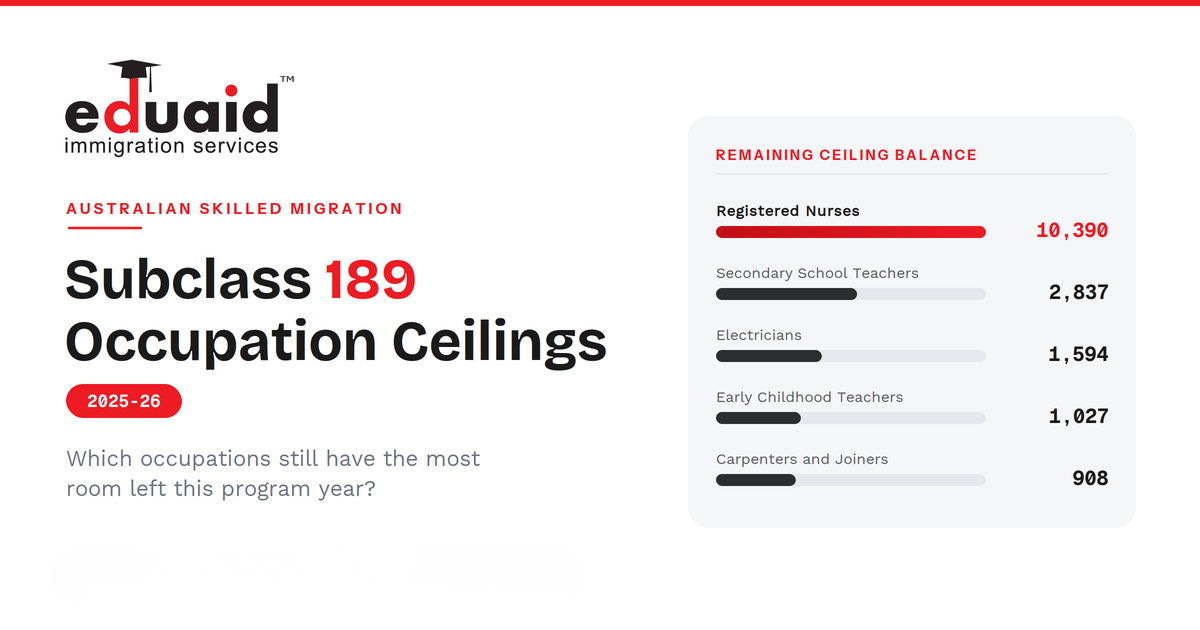
The Department of Home Affairs has released occupation ceiling data for the 2025-26 program year (FOI request FA 26/01/00545). Among the highlighted occupations, Registered Nurses show the highest remaining balance (10,390), followed by Secondary School Teachers (2,837), Electricians (1,594), Early Childhood Teachers (1,027), and Carpenters and Joiners (908). A higher balance means more room within that occupation’s ceiling, but it is not a guaranteed invitation, a confirmed visa place, or a new invitation round. Invitations still depend on your points score, EOI ranking, and how the Department manages each round.
This update breaks down what the figures show, what they do not mean, and how to read them as a planning signal within the reformed 2025-26 Subclass 189 system.
Subclass 189 Occupations With Higher Remaining Ceiling Balances
The occupations below show some of the higher remaining ceiling balances in the released data.
| Occupation | Remaining Ceiling Balance |
|---|---|
| Registered Nurses | 10,390 |
| Secondary School Teachers | 2,837 |
| Electricians | 1,594 |
| Early Childhood (Pre-primary School) Teachers | 1,027 |
| Carpenters and Joiners | 908 |
Source: Australian Government, Department of Home Affairs. FOI Reference: FA 26/01/00545.
These figures are useful for applicants reviewing their Australian skilled migration options, but they are planning signals rather than guaranteed opportunities. The number tells you how much headroom is left in the ceiling, not how likely you personally are to be invited.
What Is an Occupation Ceiling?
An occupation ceiling is part of the Department of Home Affairs policy guidance for managing invitations under selected skilled migration pathways. It sets an upper limit on how many Expressions of Interest within a specific occupation group can be invited during a program year, which stops any single occupation from dominating the intake.
A ceiling is a management tool, not a queue position or a personal allocation. It is also not the same as the number of visas that will ultimately be granted. The Department has been clear that ceilings can change, and that their implementation depends on operational circumstances, relevant Ministerial Directions, and Australian Government priorities.
How the 2025-26 Subclass 189 Model Changed
This context matters when reading the ceiling data, because the 2025-26 program year runs on a reformed SkillSelect framework rather than the old rolling model.
Three changes stand out. The Skilled Independent (Subclass 189) planning level for 2025-26 is 16,900 places, which sits below several other parts of the Skill stream, including State and Territory Nominated and Employer Sponsored programs. Invitation rounds now follow a more structured, pre-announced schedule, and the 13 November 2025 round issued 10,000 invitations. Under the new logic, Subclass 189 effectively receives the remaining quota after state, territory, and employer programs use their allocations.
The practical takeaway: a large remaining ceiling balance does not automatically translate into a flood of invitations. The total 189 planning level, round scheduling, and applicant ranking all sit above the occupation ceiling in the decision chain.
What Does a Higher Remaining Balance Mean?
A higher remaining balance means an occupation has more room left within its ceiling compared with occupations showing a lower balance. Registered Nurses, for example, show 10,390 remaining while Carpenters and Joiners show 908, which gives a useful view of the broader planning position across occupations.
It does not mean that every eligible applicant in that occupation will be invited. Within each occupation group, higher-ranked Expressions of Interest are invited first, so you compete against everyone else in your ANZSCO code, not against the ceiling number itself.
What the Data Does Not Mean
The latest occupation ceiling data should not be read as any of the following:
- A guarantee that an invitation will be issued
- A confirmed number of visas available to new applicants
- A live count of invitations remaining
- A new Subclass 189 invitation round
- A guarantee of visa approval after an invitation
The data is one part of a much broader process. Some occupations can even show a negative balance, which happens when grants across related programs exceed the originally calculated ceiling, and those occupations may receive few or no 189 invitations for the year.
What Factors Can Affect a Subclass 189 Invitation?
Even with a large remaining balance, an invitation still depends on several factors working together:
- Your points score
- The competitiveness of your Expression of Interest (EOI)
- Demand within your nominated occupation
- Your skills assessment
- Your English language proficiency
- Relevant Ministerial Directions and Australian Government priorities
- Operational circumstances
- How future invitation rounds are planned
The minimum points threshold for points-tested skilled visas is 65, but reaching 65 does not guarantee an invitation. In competitive occupations, applicants often need a significantly stronger profile to improve their position in the ranking.
Which Visa Programs Do Occupation Ceilings Apply To?
According to the Department of Home Affairs, occupation ceilings apply to the Skilled Independent visa (Subclass 189) and the Skilled Work Regional (Provisional) visa (Subclass 491), Family Sponsored stream.
They do not apply to the Skilled Nominated visa (Subclass 190), other State and Territory Nominated skilled visa programs, or Employer Sponsored visa programs.
This distinction matters for strategy. If your occupation is tight or exhausted under 189, the same occupation may still be active through a state or territory nomination or an employer sponsored pathway, each of which runs on its own occupation lists and selection logic.
How Are the Remaining Ceiling Balances Calculated?
The FOI release explains that the Department uses employment stock data and occupation-specific multipliers to set each occupation ceiling. The remaining balance is then calculated after accounting for relevant visa grants from the previous program year.
This gives a planning view of the ceiling position for 2025-26. It should not be treated as a real-time measure of invitation availability.
Should Applicants Change Their Strategy Based on This Data?
The data is useful, but it should never be the only factor guiding a migration decision. A strong strategy reads it alongside the rest of your profile.
Before acting, weigh up these elements together:
- Whether your occupation is eligible for the relevant visa pathway
- Your current points score, and whether you can realistically improve it
- Your skills assessment status and English test results
- Your work experience and age
- Your partner’s eligibility, where relevant
- State and Territory nomination, regional, and Employer Sponsored options
For some applicants, Subclass 189 remains a suitable option. For others, a State Nominated, regional, or Employer Sponsored pathway is more realistic. The right approach depends on the full profile, not a single data point, and relying on one pathway is the most common planning mistake we see.
Frequently Asked Questions
Does a higher occupation ceiling balance increase my chance of a Subclass 189 invitation?
A higher balance indicates more room within the relevant ceiling, but it does not guarantee an invitation. Your points score, EOI competitiveness, occupation demand, and government priorities still determine the outcome.
Is this a new Subclass 189 invitation round?
No. The FOI data is not a round announcement. It is occupation ceiling planning data for the 2025-26 program year.
Do occupation ceilings apply to the Subclass 190 visa?
No. Occupation ceilings do not apply to State and Territory Nominated programs, including the Skilled Nominated visa (Subclass 190).
Do occupation ceilings apply to the Subclass 491 visa?
They apply to the Subclass 491 Family Sponsored stream. State and Territory Nominated 491 pathways are managed separately.
Is 65 points enough to receive a Subclass 189 invitation?
65 is the minimum threshold, not a guarantee. Competitive occupations often require a stronger points score and overall profile to be invited.
What is the Subclass 189 planning level for 2025-26?
The Skilled Independent planning level for 2025-26 is 16,900 places, which is smaller than several other parts of the Skill stream, including State and Territory Nominated and Employer Sponsored programs.
Should I submit or update my EOI?
Your EOI should accurately reflect your current qualifications, work experience, English results, and skills assessment. You can update it before receiving an invitation if your circumstances change.
Key Takeaway
The latest occupation ceiling data offers useful insight into the 2025-26 skilled migration planning landscape. Several occupations, including Registered Nurses, Secondary School Teachers, Electricians, Early Childhood Teachers, and Carpenters and Joiners, show higher remaining balances.
But the figures are a planning signal, not a promise. The most suitable pathway always depends on your individual profile: your occupation, points score, qualifications, experience, and circumstances.
Explore Your Australian Skilled Migration Options
Thinking about skilled migration to Australia? Contact eduaid to discuss your profile and explore the visa pathway that may be most suitable for your qualifications, experience, points score, and individual circumstances. Reading the ceiling data correctly is the first step, and building a plan around your strongest route is what moves you forward.
Source: Australian Government, Department of Home Affairs. FOI Reference: FA 26/01/00545.
Disclaimer: This article provides general information only and does not constitute migration advice. Migration requirements, policies, and priorities may change, and occupation ceilings are subject to operational circumstances, relevant Ministerial Directions, and Australian Government priorities. Applicants should seek advice based on their individual circumstances.